The United States stepped back from the brink of default on Tuesday but congressional approval of a last-ditch deficit-cutting plan failed to dispel fears of a credit downgrade and future tax and spending feuds.

President Barack Obama and lawmakers from across the political divide expressed relief over the hard-won compromise to raise the country's borrowing authority after weeks of rancorous partisan battles.
Nevertheless, U.S. stocks tumbled, turning negative for the year, as investors shifted their attention to the increasingly grim state of the U.S. economy and the potential for a downgrade of America's gold-plated debt rating.
That risk grew when one of the three major ratings agencies said it was affirming the U.S. government's AAA-rated sovereign debt but slapping it with a negative outlook.
The announcement by Moody's Investors Service after U.S. markets closed could lead to a downgrade within 12 to 18 months. That could raise borrowing costs for U.S. companies and consumers as the economy risks slipping back into recession.
The Senate's approval by 74-26 votes of the $2.1 trillion deficit-reduction plan warded off the immediate specter of a catastrophic U.S. debt default. The bill passed the Republican-controlled House of Representatives on Monday.
Obama immediately signed it into law, lifting the $14.3 trillion debt ceiling with just hours to spare before the government was due to run out of money to pay all its bills.
The bitter feud between Democrats and Republicans has bruised Obama as he heads into a campaign to win a second term in 2012.
The $2.1 trillion deficit-reduction plan fell well short of a $4 trillion 'grand bargain' that was nearly agreed last month between the White House and congressional leaders.
Another ratings agency, Standard & Poor's has said $4 trillion in deficit-reduction measures would be needed as a "downpayment" to put America's finances in order.
S&P said in mid-July there was a 50-50 chance it would cut the U.S. rating in the next three months if lawmakers failed to craft a meaningful deficit-cutting plan. Investors are on tenterhooks about the chance of a downgrade by S&P.
The deal leaves political battles ahead over spending cuts and tax reform as the deficit-cutting plan is implemented. Obama and Democratic and Republican leaders said the agreement, while a welcome first step, was not enough on its own.
"We just kicked the can down the road ... the agreement doesn't really do anything about what got us into debt," Republican Senator Lindsey Graham told Reuters Insider.
"We had a good opportunity, we let it pass so we will keep struggling."
China, the largest creditor to the United States, urged Washington to act responsibly to deal with its debt issues, saying uncertainty in the U.S. Treasuries market will undermine the global monetary system and hamper global growth.
"We hope that the U.S. government and the Congress will take concrete and responsible policy measures ... to properly deal with its debt issues, so as to ensure smooth operation of the Treasury market and investor safety," central bank chief Zhou Xiaochuan said, in China's first official reaction to the last-minute passage of the U.S. debt deal.
THREAT OF CHAOS RECEDES
The deal drew a line -- for the moment -- under months of bitter partisan squabbling over debt and deficit strategy that had threatened chaos in global financial markets and dented America's stature as the world's economic superpower.
The law lifts the debt ceiling enough to last beyond the November 2012 elections, calls for $2.1 trillion in deficit savings spread over 10 years and creates a bipartisan joint House and Senate committee to recommend further cuts by late November. It does not yet include any tax increases.
International Monetary Fund chief Christine Lagarde said the deal reduced uncertainty in the markets.
The governor of the central bank of China, the biggest foreign holder of U.S. Treasuries, urged the United States to responsibly protect investor interests.
Questions lingered about the fragile U.S. economy and whether the bipartisan deficit-cutting compromise could deliver the desired results.
Data on Tuesday showed U.S. consumer spending dropped in June for the first time in nearly two years and incomes barely rose, the latest in a string of gloomy economic indicators.
Moody's said the deal was a step toward fixing the budget problems but the United States risked a downgrade if fiscal discipline weakened in the coming year, if no further steps were taken in 2013 or if the economy deteriorated.
"We would expect that growth would accelerate in 2012 from the first half of the year," Steven Hess, Moody's top U.S. analysts told Reuters in an interview. "But if it doesn't, that means that the whole process of fiscal consolidation and the plans to achieve lower deficits and lower debt ratios will be made all the more difficult.
Fitch Ratings did not rule out putting a negative outlook on the U.S. AAA rating when it concludes a review of the country later this month, the agency's top analyst for the United States told Reuters on Tuesday.
TUSSLE OVER TAXES
Investors said the move by Moody's on Tuesday was expected and did not ruffle financial markets.
Earlier, Wall Street stocks slumped broadly by more than 2 percent, ending down for a seventh consecutive session as gloom over the economy mounted, marking the longest losing streak since the financial crisis period in October 2008.
"I think that the most troubling aspect we have going on right now is the performance of U.S. equities. The equity market for whatever reason seems to think that this deal is not sufficient," said Greg Salvaggio, senior vice president at Tempus Consulting in Washington.
U.S. Treasury Secretary Timothy Geithner said in an opinion piece in the Washington Post that the debt deal should allow room for Congress to implement short-term measures to strengthen the economy this fall such as extending a payroll tax cut and funding infrastructure projects.
Obama said the sacrifices required to reduce the deficit needed to be fairly shared, apparently nodding to anger among many Democrats that the deal did not include tax increases and risked hurting social programs.
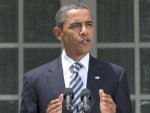
"We cannot balance the budget on the back of the very people who have borne the brunt of the recession ... everyone is going to have to chip in, that's only fair," the president said in an address from the White House Rose Garden.
He said he expected tax reform to emerge from deliberations by the new congressional committee, and that a "balanced approach" in which the wealthier pay more taxes was needed.
Only moments after final passage, rival congressional leaders were handing out their political recipes for the way forward -- Republicans in favor of more spending cuts, and Democrats looking for tax reform or hikes.
 By Olivier Knox |
At issue was the role that the young movement, born of anger at the sour US economy and stoked by establishment Republicans eager to harness its energy, could play in President Barack Obama's fight for reelection in November 2012.
"I think nothing really changes. This is, to us, the beginning of the debate," Republican Senator Rand Paul, one of the Tea Party's champions in the polarized US Congress, told AFP when asked what would happen next.
"We're going to continue to promote solutions, as opposed to deals. I think this is a deal, not a solution," Paul said of the 11th-hour compromise agreed by Obama and top Republicans to avert a disastrous debt default.
Paul shrugged off public opinion polls showing that the Tea Party emerged from the spectacle of the acrimonious six-months-long debt debate with its image tarnished.
"I don't see anything about my perception of the public's will that tells me I need to do less. They tell me I need to keep doing the same thing and tell me to stand my ground," the Kentucky lawmaker said.
A fresh survey from the Pew Center that studies US public opinion found that 42 percent of Americans had a less favorable view of Republicans, 37 percent thought less of the Tea Party, and 30 percent viewed Democrats less positively.
Republican respondents were among the most divided: 56 percent of Republicans and Republican-leaning independents who agreed with the Tea Party said their impression of members of Congress tied to the movement had improved.
But just four percent of Republicans who disagree with, or are neutral towards, the Tea Party, said they felt more positively about the movement, against 27 percent who reported thinking more negatively.
Political analysts said the split would ultimately matter little and predicted Republicans would unite behind their standard-bearer in the November 2012 race, when the party hopes to retake the White House.
"Those fissures are going to recede, and the Republican party is likely to become more united on the issue of creating jobs and attacking Obama's record," according to Matt Dickinson, a political scientist at Middlebury College.
Dickinson noted then-president Bill Clinton overcame lackluster approval ratings to coast to reelection in 1996 after campaigning in large part against congressional Republicans he convinced voters were radical.
But while Obama might be similarly politically "blessed by his enemies," Clinton "was never in these dire straits economically," Dickinson told AFP recently.
A senior Republican senate aide agreed, telling AFP: "We could have the party broken into 17 factions in open warfare, but by summer of 2012 everyone will be holding hands against Obama."
Other key Tea Party figures joined Paul in ultimately opposing the legislation, arguing the massive austerity deal they helped to pull sharply rightward was ultimately insufficient to get Washington's fiscal house in order.
They included Republican Representatives Michele Bachmann as well as Republican Senators Mike Lee and Jim DeMint -- widely considered the Tea Party's most influential patron in the US Congress.
"It's time to stop the 'hot air' in Washington and let the winds of true change, economic growth and job creation spurred by the private market sweep through this country. Someone has to say NO to more spending. I will," said Bachmann.
In the House of Representatives, however, 59 of the so-called "freshmen" elected in November 2010 elections shaped by the Tea Party ultimately sided with Republican leaders in backing the legislation, while 28 opposed it.
And more than half of the "Tea Party Caucus" in the House backed the bill.
House Republicans were more united behind the bill than Obama's Democratic allies, who broke 95-95 amid angry criticisms that the bill cut middle-class programs while failing to increase taxes on the rich and wealthy corporations.
That doesn't mean Tea Party adherents will set aside their often fiery, take-no-prisoners approach, said Dickinson.
"A good chunk of them think they are doing God's work, so they are not amenable to the kinds of deals that more pragmatic lawmakers, like their leaders, may find reasonable," he said.
 Meet the new Super Congress
Now that Congress has agreed on a general framework to raise the debt ceiling, party leaders will establish a bipartisan committee of lawmakers from both …
 Why Americans hated the debt debate
Pew came out with a new poll on Monday confirming what we all already knew: The American people think the last several weeks in Washington have been a …
 US Tea Party at crossroads after debt deal
The US Tea Party stood at a political crossroads Tuesday, split by a vote on raising the US debt limit after fractious negotiations that saw them declared …
 Senate passes bill to prevent US default
The U.S. avoided a feared and catastrophic default on the American debt, as lawmakers on Tuesday passed a measure that ties an agreement to raise the government's …
 Obama shifts focus to jobs and taxes, away from debt talks
President Barack Obama appeared in the Rose Garden this afternoon, shortly after the Senate approved the debt-